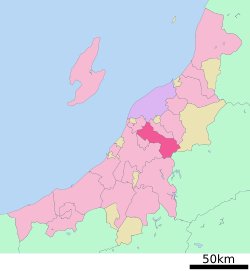

Key City: Shibata is another example of a city that prospered and grew around a castle. The castle was founded in the 1590’s by Mizoguchi Hidekatsu, but it wasn’t completed until the mid 1600’s by his great-grandson. At the height of its power, the castle was made up of 11 keeps and 5 gatehouses. By all accounts it was a sight to behold.
This type of castle was constructed of wood and usually built next to a lake or surrounded by a moat. If you visit the castle today, you can walk through the

remaining gatehouse, but visitors aren’t allowed to cross the moat.
At that time, one of the greatest threats to large structures was fire. They didn’t have access to reliable fire-prevention methods or fire extinguishers, so if a wooden building caught fire, it had to be dealt with quickly or the building was surely lost. Imagine constructing a castle complex like Shibata all made of wood. You’d be worried too!
 If you look at the top of the castle in these pictures, you’ll notice there are three points sticking up on the roof. If you look really close, you’ll see that they are three fish-like creatures, called Shachihoko (or Shachi for short). A literal translation would be something like “killer whale.” They have faces like lions with long teeth and the bodies of big fish. Weird decoration, you think?
There is actually some rationale behind it. In the country of India, the god of water supposedly rode on similar creatures, and when Buddhism made its way into China and eventually Japan, it brought this symbolism with it. Mizoguchi Hidekatsu followed the  common practice of his day by placing these figures on the roof of his castle in the hope that this god would protect him from fire. In fact, Shibata Castle is the only one known to have three Shachi per roof instead of two. He really wanted to protect his life’s work.
Not to be too heavy-handed with this, but can’t you see the spiritual lessons to this story? If only there had been someone to say, “Let me introduce you to the God who can protect you from fire for all eternity!” Will you pray for Shibata, a city with over 100,000 people destined for a fiery eternity?