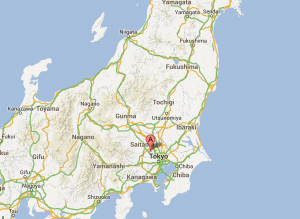
Like most other large cities in Japan, Fujimino, has many claims to fame, but I want to look at one of its most famous visitors, Tokugawa Ieyasu.
If you go to Fujimino right now, you’ll find a bustling metropolis with factories and acres of asphalt, but in the 1600’s it was a farming community with a beautiful river cutting through the deep green valley.
Tokugawa Ieyasu had been fighting on and off his entire life, and in 1603 he won a decisive battle and gained the title shogun at the age of 60. The word shogun means “military commander” but in practice it meant Ieyasu (ruler of Japan.)
After 50 years of fighting, though, he had a real problem. The people of Japan had learned that war was life. Every grown man was a warrior. It would be difficult to unite them and keep peace over a land where most people had known only battle for most of their lives.
So he created a strict set of rules to govern hunting and used it as a tool to transform the wartime violence of the past into a peacetime competition among equals for bragging rights. Effectively, he replaced war with hunting, and it worked. The status symbols of the day changed from war-trophies to prized birds of prey.
 You may ask why this matters, and that would be a fair question. Tokugawa Ieyasu wanted to create a dynasty and to do what he needed for political peace united under him. He cleverly overcame the specter of war from Japan’s past, but there was another problem that he couldn’t figure out how to turn to his advantage: Christianity.
In 1614, as a last resort, he banned Christianity from Japan by signing the Christian Expulsion Act. He literally exiled Christians from his country, and he made no distinction between Catholic and Protestant. He thought they were all just too much trouble.
 Amazingly, Ieyasu’s plans worked out as he’d hoped and his family ruled Japan for 250 years, but he unwittingly sentenced himself and his people to an eternity separated from God.
It wasn’t until 1871 that freedom of religion was reintroduced in Japan, and even after that there has been very few Christian missionaries entering the country. It’s estimated that less than 1 million Japanese have trusted Jesus Christ as their only hope for salvation.
What does all this mean? In a nutshell, Japan is like any other country: it needs to hear the Gospel, and that just isn’t happening in the vast majority of Japan! We’re too far behind. We need more help. In fact, we need your help. Would you join us in our endeavor of taking the Gospel to Japan?


